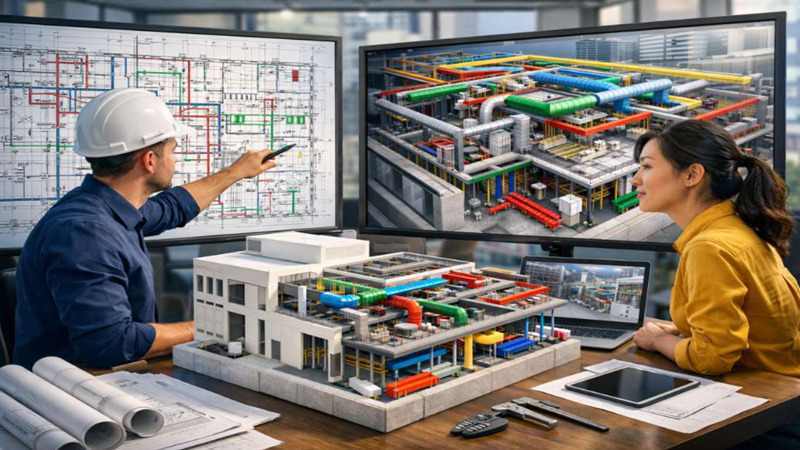
Design coordination has become one of the biggest challenges in modern construction and product development. Projects today are no longer linear; they involve multiple disciplines working simultaneously across locations, time zones, and software platforms.
Architects, structural engineers, MEP consultants, contractors, and project managers must all collaborate efficiently. Yet misaligned drawings, outdated revisions, and communication gaps still lead to costly mistakes.
This is exactly why more firms are integrating 2D & 3D Modeling Services into unified workflows. Instead of treating 2D drafting and 3D modeling as separate processes, forward-thinking AEC and engineering teams are combining them to improve clarity, coordination, and control.
Let’s explore how this hybrid approach is reshaping design coordination, especially across the UK’s evolving construction landscape.
Why Is Design Coordination So Challenging Today?
Modern projects are more complex than ever. Mixed-use developments, sustainable building regulations, prefabrication, and digital approvals have added layers of technical requirements.
Common coordination issues include:
- Structural and MEP clashes
- Inconsistent drawing revisions
- Misinterpretation of 2D documentation
- Delayed approvals
- Site-level rework
According to research highlighted by McKinsey & Company, rework in construction can account for up to 30% of total project costs in large-scale developments. Much of that stems from poor coordination and documentation errors.
When 2D drawings exist independently from 3D models or worse, when only one format is used information gaps multiply.
This is where integrated 2D & 3D Modeling Services make a measurable difference.
What Are 2D & 3D Modeling Services And Why Combine Them?
2D Modeling Strengths
Traditional 2D drawings remain essential for:
- Permit submissions
- Construction documentation
- Contract documentation
- On-site execution
Detailed CAD layouts ensure regulatory compliance, especially in the UK where planning authorities require highly structured documentation.
3D Modeling Strengths
Meanwhile, 3D CAD Modeling Services provide:
- Realistic visualization
- Clash detection
- Cross-disciplinary coordination
- Improved stakeholder communication
When these two approaches operate together, firms gain a synchronized design ecosystem rather than disconnected outputs.
How Do 2D & 3D Modeling Services Improve Cross-Disciplinary Coordination?
1. Creating a Single Source of Truth
When 2D drawings are generated directly from coordinated 3D models, discrepancies between disciplines are significantly reduced.
Instead of manually updating separate drawings, teams work from a unified environment through structured CAD Modeling Services. This ensures:
- Updated revisions flow across all documents
- Structural, architectural, and MEP models align
- Documentation reflects the most current design intent
This synchronization reduces costly misunderstandings.
2. Detecting Clashes Before Construction Begins
One of the biggest coordination advantages of 3D CAD Modeling and Design Services is early clash detection.
In traditional workflows, conflicts between structural beams, HVAC ducts, and plumbing lines are often discovered onsite. By then, the financial and time impact is significant.
With integrated modeling:
- Structural and MEP elements are layered digitally
- Interference is identified early
- Redesign happens before site work begins
This proactive approach supports better cost control and scheduling reliability.
3. Improving Communication Across Stakeholders
Let’s be honest: many stakeholders struggle to interpret complex 2D drawings.
Clients, investors, and planning authorities often benefit from visual clarity. 3D modeling enhances understanding, while 2D documentation ensures formal compliance.
This dual format:
- Reduces approval cycles
- Minimizes back-and-forth clarifications
- Supports clearer decision-making
In the UK’s regulated planning environment, this advantage is particularly valuable.
Why Are UK Firms Rapidly Adopting Hybrid Modeling Workflows?
The UK construction sector has embraced digital transformation faster than many global markets.
Several factors drive adoption:
- Strong BIM implementation standards
- Government-backed digital construction mandates
- High regulatory documentation requirements
- Emphasis on sustainability and cost transparency
According to the NBS Digital Construction Report, BIM adoption in the UK remains consistently high, with firms increasingly integrating hybrid documentation workflows.
This naturally increases demand for professional 3D CAD Modeling Services alongside traditional drafting processes.
How Do 2D & 3D Modeling Services Reduce Rework?
Rework is one of the most expensive risks in any AEC project.
When design changes occur late in the process, updates must be reflected across multiple documents. Without integration, errors easily slip through.
Combining 2D and 3D workflows:
- Ensures model-driven drawing generation
- Maintains version consistency
- Reduces duplication of effort
- Improves change management
For engineering firms managing multiple stakeholders, this level of synchronization enhances reliability and accountability.
Can Smaller Firms Benefit from Integrated Modeling?
Absolutely.
SMEs often assume advanced modeling workflows are only for large enterprises. In reality, small and mid-sized firms often gain even more strategic advantage.
Benefits include:
- Ability to compete for larger contracts
- Improved client confidence
- Reduced dependency on manual coordination
- Faster project turnaround
Many firms collaborate with a specialized 3D Modeling Company to access expert support without expanding internal overhead.
What Trends Are Shaping the Future of Design Coordination?
The next phase of digital transformation is focused on interoperability and automation.
Emerging trends include:
- AI-assisted clash detection
- Cloud-based collaborative modeling
- Automated 2D drawing extraction from 3D models
- Integration with digital twins
- Sustainability-focused modeling
Forward-thinking CAD Modeling Services providers are aligning workflows to support these innovations.
Hybrid modeling is no longer optional; it’s becoming standard practice.
How Does This Impact Cost, Time, and Quality Control?
The benefits go beyond visualization.
Integrated 2D & 3D Modeling Services improve:
Cost Control
- Accurate quantity take-offs
- Reduced material waste
- Fewer change orders
Schedule Reliability
- Faster approvals
- Reduced RFIs
- Fewer site-level disruptions
Quality Assurance
- Coordinated documentation
- Improved compliance
- Better construction sequencing
This trifecta cost, time, and quality is what every business owner and project leader cares about most.
Is 3D Replacing 2D Completely?
No.
While 3D modeling is expanding rapidly, 2D documentation remains a regulatory and contractual necessity.
The real evolution is integration not replacement.
Architects and engineers still need detailed 2D construction drawings, but they now generate them more efficiently from coordinated 3D environments.
That balance is where true design coordination excellence exists.
Final Thoughts
The complexity of modern AEC projects demands more than traditional drafting or standalone 3D models.
By combining 2D & 3D Modeling Services, firms gain:
- Clearer collaboration
- Reduced risk
- Greater design accuracy
- Faster stakeholder approvals
- Stronger project control
In the UK and globally, firms that embrace this integrated approach are positioning themselves for long-term competitiveness.
As demand for seamless coordination grows, many companies are partnering with experienced UK-based CAD specialists who understand both local regulations and global best practices quietly ensuring smoother delivery across disciplines.
FAQs:
1. What are 2D & 3D Modeling Services in AEC projects?
2D & 3D Modeling Services combine traditional CAD drawings with detailed 3D digital models. While 2D drawings provide permit-ready documentation and construction details, 3D CAD Modeling Services improve visualization and coordination across architectural, structural, and MEP teams.
2. Why are AEC firms combining 2D and 3D modeling?
AEC firms combine both to reduce design conflicts, improve revision control, and enhance collaboration between disciplines. Integrated workflows ensure that drawings and models remain consistent throughout the project lifecycle.
3. How do 3D CAD Modeling Services improve design coordination?
3D CAD Modeling Services allow teams to detect clashes, align structural and MEP systems, and resolve conflicts before construction begins. This minimizes rework and improves schedule reliability.
4. Are 2D drawings still important in a 3D-driven industry?
Yes. 2D drawings remain essential for regulatory approvals, contractor execution, and legal documentation—especially in the UK where compliance standards are strict.
5. How do 2D & 3D Modeling Services reduce project risks?
By integrating both formats, firms can detect errors early, avoid miscommunication between disciplines, and ensure that construction documentation reflects accurate model data.
6. Can small and mid-sized firms benefit from integrated modeling services?
Absolutely. Smaller firms often outsource to a specialized 3D Modeling Company to access advanced modeling capabilities without expanding internal teams, improving efficiency and scalability.
7. How do integrated CAD Modeling Services support BIM workflows?
Hybrid modeling aligns well with BIM processes. 3D models enhance coordination and data sharing, while 2D drawings ensure compliance with planning and construction requirements.
8. Why is this approach gaining popularity in the UK construction sector?
UK AEC firms face strict building regulations and increasing project complexity. Combining 2D & 3D Modeling Services improves approval speed, cost control, and coordination across stakeholders.
9. What industries benefit most from 2D and 3D modeling integration?
Commercial construction, residential developments, infrastructure projects, and industrial facilities benefit most from integrated modeling workflows.
10. What should businesses look for in a CAD Modeling Services provider?
Businesses should evaluate technical expertise, experience with UK standards, turnaround times, multi-disciplinary coordination capabilities, and data security compliance.